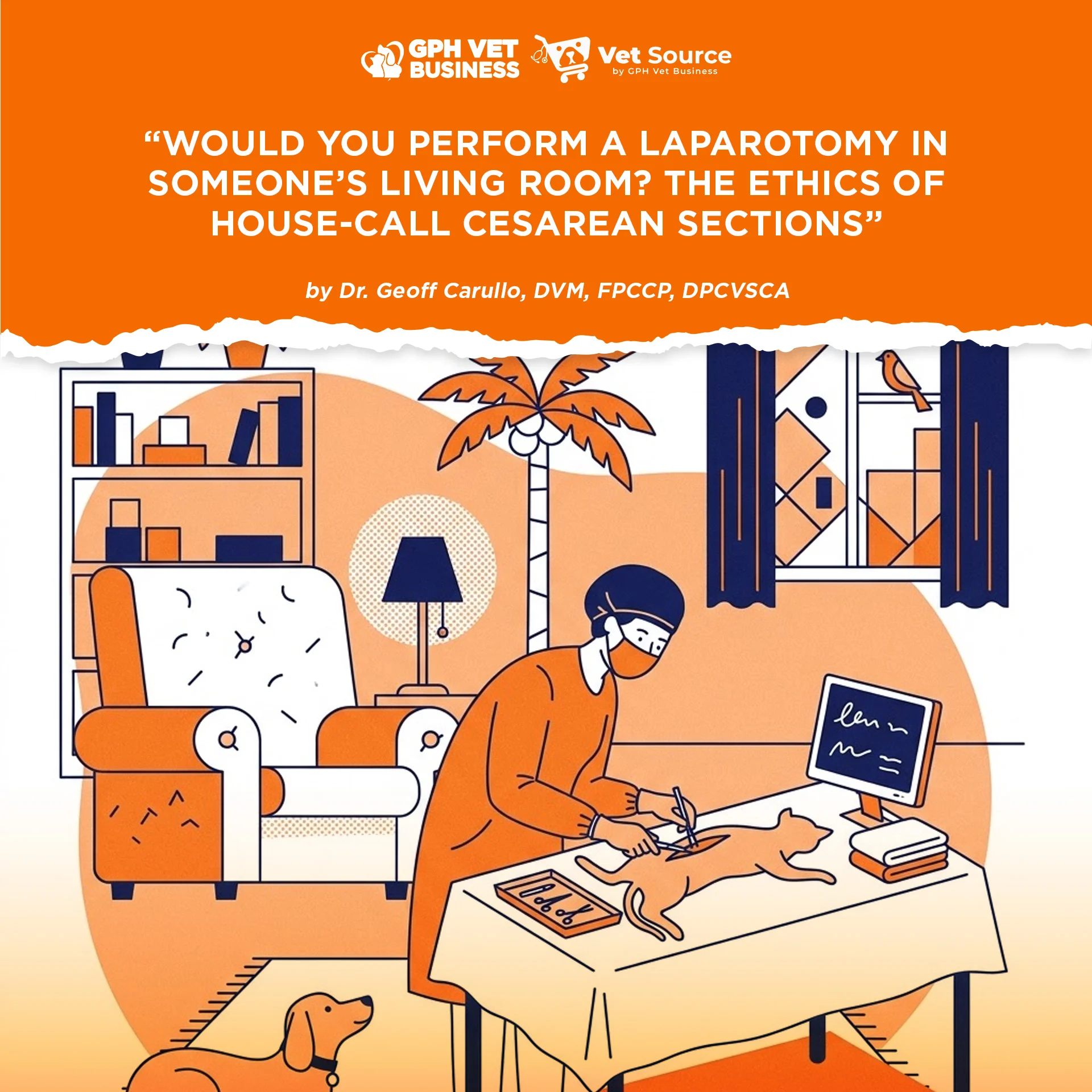
Would You Perform a Laparotomy in Someone’s Living Room? The Ethics of House-Call Cesarean Sections
Dr. Geoff Carullo, DVM, FPCCP, DPCVSCA
- Articles
- 3 min read
Let me raise a question that might make some veterinary surgeons uncomfortable.
Since when did major abdominal surgery become a routine house-call service?
I have nothing against veterinarians providing home consultations, vaccinations, or other ambulatory services.
But performing a cesarean section inside a private residence?
That deserves serious professional scrutiny.
We are talking about a major surgical procedure involving laparotomy, hysterotomy, general anesthesia, fetal extraction, and postoperative recovery.
This is not a minor procedure.
And surgical competence alone does not automatically make a residential environment an appropriate operating facility.
What if the dam develops severe intraoperative hemorrhage and hypovolemic shock?
What if anesthetic-induced hypotension compromises uteroplacental perfusion?
What if the patient experiences hypoxemia, cardiac arrhythmia, or cardiopulmonary arrest?
What if multiple neonates require immediate respiratory support and resuscitation?
Where are the anesthetic monitoring equipment, oxygen delivery systems, capnography, emergency medications, and trained surgical assistants?
And if the patient crashes, is the emergency plan simply to transport her to a veterinary hospital where the surgery could have been performed in the first place?
Under BAI Administrative Order No. 54, Series of 2000, Section 1.5, surgical procedures involving small companion animals must be performed within BAI-registered surgical veterinary clinics or hospitals, with limited exceptions for minor wounds requiring suturing.
A cesarean section clearly does not qualify as minor wound management.
This raises serious questions about the regulatory compliance of routinely performing such procedures in private residences.
Perhaps you have.
But a hundred successful surgeries do not automatically establish that the surgical environment is safe.
Experience does not eliminate anesthetic complications.
Technical proficiency does not replace perioperative monitoring.
And successful outcomes do not necessarily justify operating under suboptimal conditions.
Certainly, genuine obstetrical emergencies in remote locations may present difficult ethical dilemmas.
But an extraordinary emergency is different from routinely advertising major abdominal surgery as a house-call service.
I am not questioning anyone’s surgical skills.
I am questioning the professional judgment behind choosing an inadequately equipped environment for major surgery.
Just because you CAN perform a cesarean section inside someone’s house does not necessarily mean you SHOULD.
Veterinary medicine should be accessible, but accessibility must never supersede patient safety.
And here is my final question:
If a dam dies from an anesthetic or surgical complication during a house-call cesarean section, will we simply call it an unfortunate complication, or will we also question whether the operating environment contributed to her death?
Because surgical competence is not merely knowing how to operate.
It is knowing when, where, and under what conditions surgery should be performed.
Fellow veterinarians, what is your position?
Are house-call cesarean sections a legitimate extension of veterinary practice, or are we normalizing unnecessary surgical risks?
BAI Administrative Order No. 54, Series of 2000. Code of Standards for Veterinary Clinics and Hospitals for Small Companion Animals.
Grubb T, et al. (2020). AAHA Anesthesia and Monitoring Guidelines for Dogs and Cats. JAAHA, 56(2), 59–82.
Traas AM. (2008). Resuscitation of Canine and Feline Neonates. Theriogenology, 70(3), 343–348.
This article concerns cesarean sections in dogs and cats. Large-animal field surgery involves different clinical considerations.
Sharing this helps others understand what it really means to be a vet. Like and follow if you’re with us.
Dr. Geoff Carullo is a Fellow and the current President of the Philippine College of Canine Practitioners.