How long should a veterinary student remain in a six-year degree program?
Dr. Geoff Carullo, DVM, FPCCP, DPCVSCA
- Articles
- 3 min read

Six years? Eight years? Ten years?
Visayas State University (VSU) has published graduation statistics that raise serious questions about academic accountability in veterinary education.
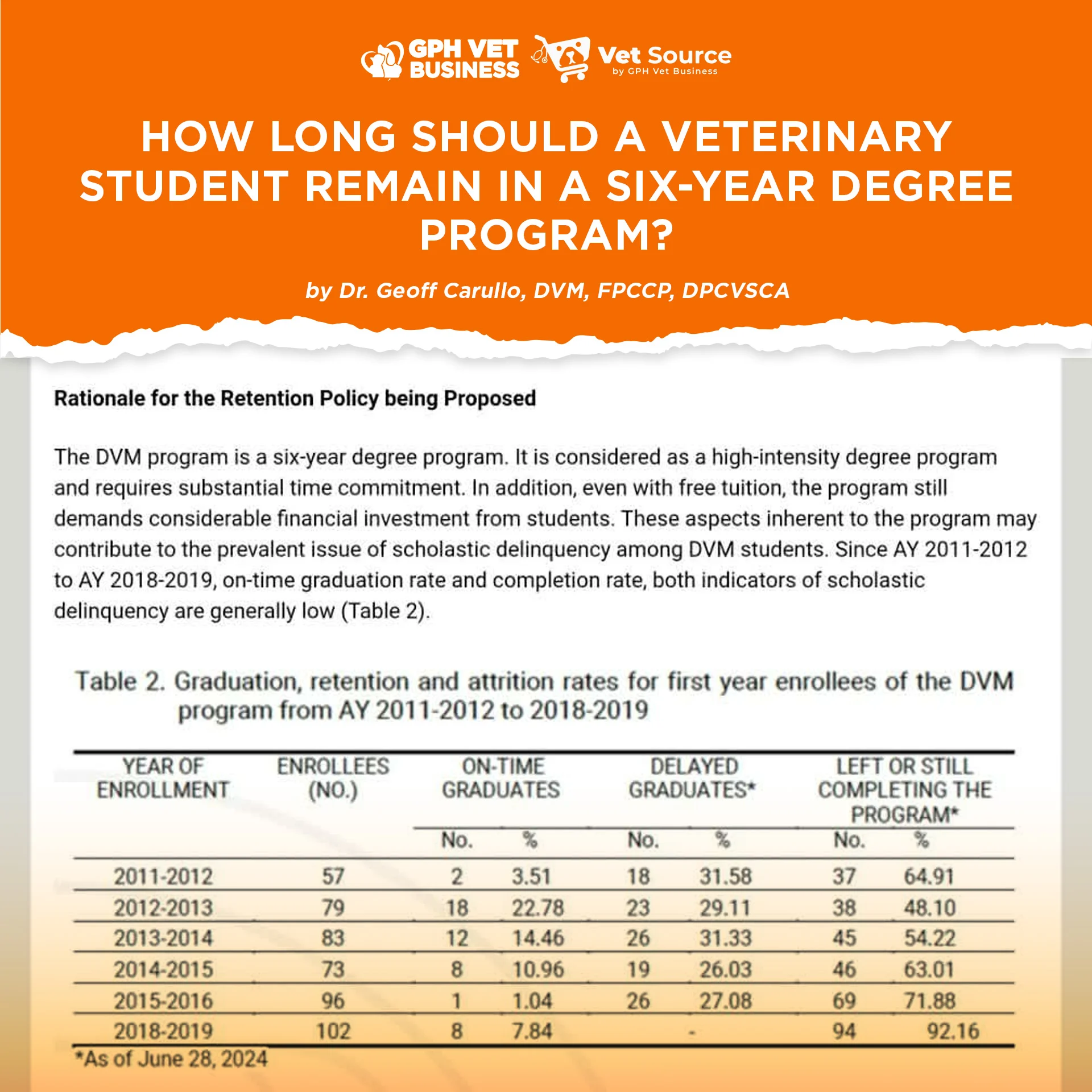
According to its official Admission and Retention Policy under BOR Resolution No. 117, series of 2024, the university has experienced consistently low on-time graduation rates.

Consider the 2015–2016 batch.
Of 96 veterinary students who enrolled, ONLY ONE graduated on time.
That’s just 1.04%.
For the 2011–2012 batch, only two out of 57 students graduated within six years.
Across five admission batches from 2011 to 2016, only 41 out of 388 students (10.6%) graduated on time.
These figures deserve serious attention.
Because public veterinary education is supported by government resources.
Every additional year of enrollment can mean continued use of classrooms, laboratories, faculty time, and university facilities.
Under Republic Act No. 10931, free tuition generally covers the prescribed program duration plus one additional year, subject to applicable exceptions.
VSU’s policy provides for a maximum residency of eight years, with a possible additional semester subject to approval.
Public education is an opportunity funded by taxpayers. It comes with academic responsibilities.
Absolutely not.
Veterinary medicine is academically demanding. Financial difficulties, personal circumstances, and institutional challenges can delay graduation.
However, being delayed should not automatically exempt students from academic accountability.
Universities must provide adequate academic support while consistently enforcing reasonable retention standards.
Interestingly, VSU itself acknowledged concerns about academic complacency and inconsistent implementation of existing academic policies.
But its historical data do not prove that free tuition caused these problems, since most of the cited batches entered before nationwide free tuition began.
The question is not whether delayed veterinary students are intelligent.
The question is whether public universities are effectively managing academic performance and helping students graduate.
Students must be accountable for their progress.
Universities must be accountable for the quality of education they provide.
And taxpayers have every right to demand transparency about institutional performance.
Because publicly funded education should produce opportunities, academic excellence, and competent graduates—not endless enrollment without accountability.
Visayas State University, Admission and Retention Policy for the Doctor of Veterinary Medicine Program, BOR Resolution No. 117, s. 2024.
Sharing this helps others understand what it really means to be a vet. Like and follow if you’re with us.
Dr. Geoff Carullo is a Fellow and the current President of the Philippine College of Canine Practitioners.