Before your next cesarean section, read this: What the Telazol and Zoletil package inserts say about their use in pregnant dogs and cats.
Dr. Geoff Carullo, DVM, FPCCP, DPCVSCA
- Articles
- 5 min read

Have you ever performed a cesarean section using tiletamine and zolazepam, commonly known as Telazol or Zoletil?
Perhaps the surgery went smoothly. The mother recovered, and the puppies or kittens were delivered.
But have you ever taken the time to read what the manufacturers actually say about using these anesthetics during cesarean sections?
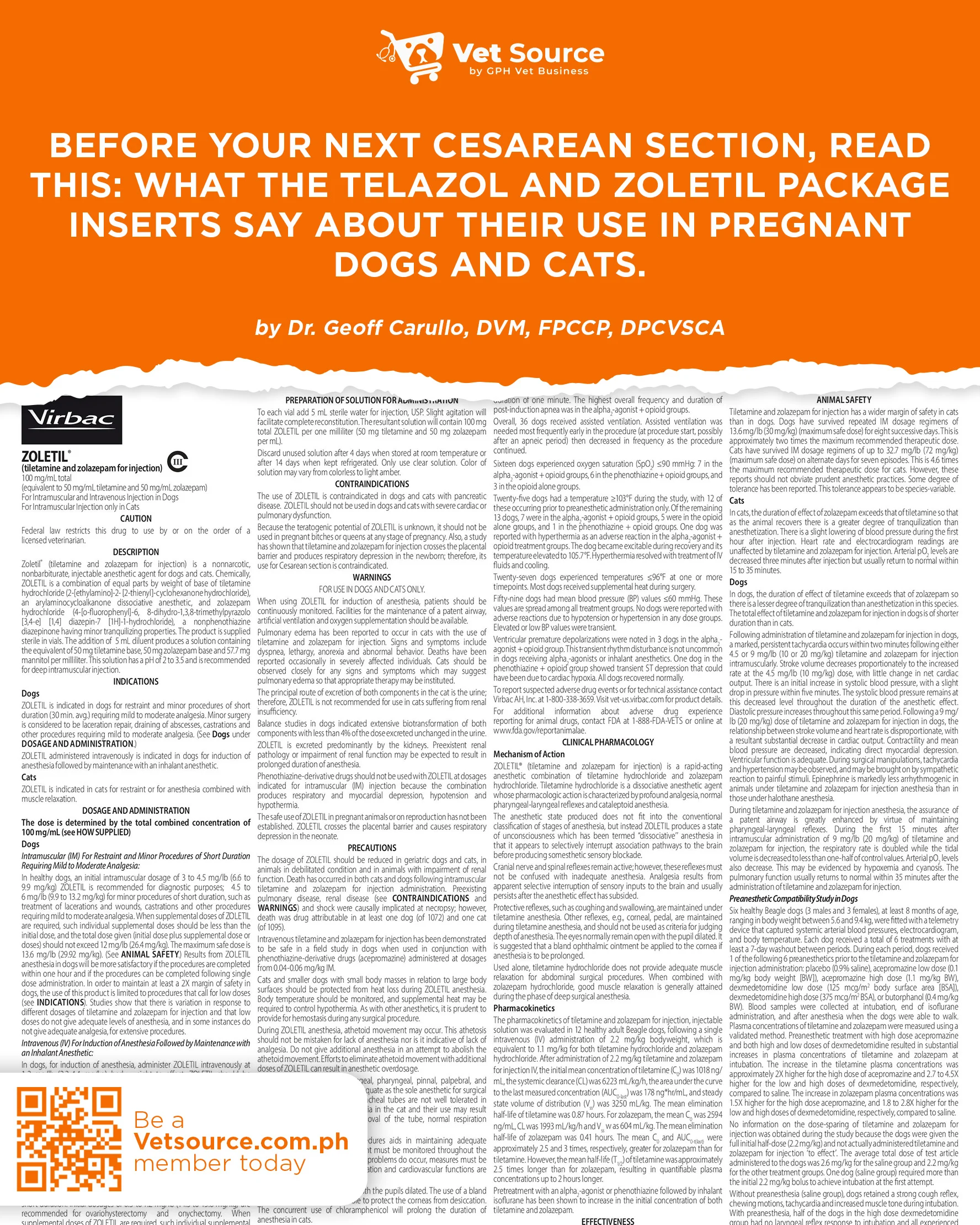
Both manufacturers identify cesarean section as a contraindication in their product labeling.
And the reason involves the safety of both the mother and her unborn offspring.


According to the official prescribing information of Zoetis Telazol and Virbac Zoletil, tiletamine and zolazepam cross the placental barrier and can cause respiratory depression in newborn animals.
Both manufacturers specifically identify cesarean section as a contraindication.
They also advise against using these products in pregnant dogs and cats.
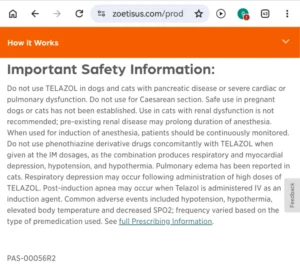
This is not simply a warning to reduce the dosage. It is an explicit contraindication stated in the product information.


In routine surgery, our primary anesthetic concern is the patient undergoing the procedure.
But in cesarean sections, we have two responsibilities: the mother and her unborn offspring.
Anesthetic drugs may cross the placenta and affect fetal cardiovascular and respiratory function.
This is particularly important in patients experiencing dystocia, prolonged labor, fetal distress, or compromised uteroplacental circulation.
Imagine successfully removing a puppy from the uterus, only to discover that it is severely depressed and struggling to breathe.
Although several factors may contribute to neonatal depression, anesthetic drug exposure is one consideration.
A successful cesarean section is not measured solely by the survival of the mother. Neonatal outcomes matter just as much.
For canine and feline cesarean sections, an appropriately selected intravenous induction agent, followed by endotracheal intubation and inhalant anesthesia, is a commonly recommended approach.
Propofol and alfaxalone are established options for induction.
Isoflurane and sevoflurane are commonly recommended for maintenance because anesthetic depth can be adjusted rapidly, and these agents are primarily eliminated through the lungs.
Importantly, inhalant anesthetics also cross the placenta. Excessive anesthetic depth may cause maternal hypotension and reduce uteroplacental perfusion.
Therefore, maintaining adequate oxygenation, ventilation, blood pressure, and analgesia remains essential.
A 2025 systematic review examining anesthetic drugs and puppy vitality after cesarean section reported that injectable anesthetics used for maintenance were associated with lower neonatal vitality.
However, the researchers emphasized that differences in study methods and evidence quality made it difficult to identify one universally optimal protocol.
This supports the preference for carefully managed inhalant maintenance rather than relying on prolonged injectable anesthesia during cesarean sections.
Not necessarily.
Injectable anesthetics remain useful for induction, short procedures, and selected surgical protocols.
However, veterinarians must recognize their limitations.
The choice of anesthetic should depend on the procedure, patient condition, expected duration, and available monitoring and emergency support.
Even routine spay-neuter procedures may benefit from inhalant anesthesia.
Dental procedures also require special consideration because endotracheal intubation and airway protection are essential during general anesthesia.
The decision should never be based solely on which anesthetic is cheaper or more convenient.
I believe it is time to reconsider how we approach anesthesia in veterinary practice.
Having successfully performed a procedure using a particular anesthetic does not automatically establish that the protocol was appropriate or safe.
And the fact that a patient survived does not eliminate the possibility that unnecessary risks were taken.
For cesarean sections, inhalant anesthesia should be strongly considered as the preferred maintenance technique, together with appropriate injectable induction, airway management, monitoring, maternal analgesia, and neonatal resuscitation preparedness.
Clinics without the necessary anesthetic equipment or trained personnel should consider referral whenever feasible and clinically appropriate.
This does not mean every injectable anesthetic protocol is unsafe.
It means that drug selection must be guided by evidence, patient safety, and the manufacturer’s contraindications—not simply habit or convenience.
Telazol and Zoletil are valuable anesthetic agents in veterinary medicine.
However, their manufacturers have identified cesarean section as a contraindication because of placental transfer and the potential for neonatal respiratory depression.
That warning deserves our attention.
As veterinarians, we have a professional responsibility to understand not only what our anesthetic drugs can do, but also when they should not be used.
Because in a cesarean section, waking up the mother is only part of the success.
We must also give every puppy and kitten the best possible chance to take its first breath.
And sometimes, that responsibility begins with something as simple as reading the package insert.
Disclaimer: This article is intended for veterinary professional education. The cited product contraindications reflect the manufacturers’ prescribing information. Anesthetic management must be individualized based on patient assessment.
Dr. Geoff Carullo is a Fellow and the current President of the Philippine College of Canine Practitioners.
Sharing this helps others understand what it really means to be a vet. Like and follow if you’re with us.