Puppy tests positive for parvo just six days after purchase. Should the pet shop be held responsible?
Dr. Geoff Carullo, DVM, FPCCP, DPCVSCA
- Articles
- 6 min read

Imagine purchasing an adorable puppy from a pet shop.
You bring it home, excited to welcome a new member of your family.
Six days later, your veterinarian delivers devastating news.
Your puppy has tested positive for canine parvovirus.
Naturally, you begin asking questions.
Was the puppy already infected when you purchased it?
Did the pet shop sell you a sick animal?
And most importantly, who should be held responsible?
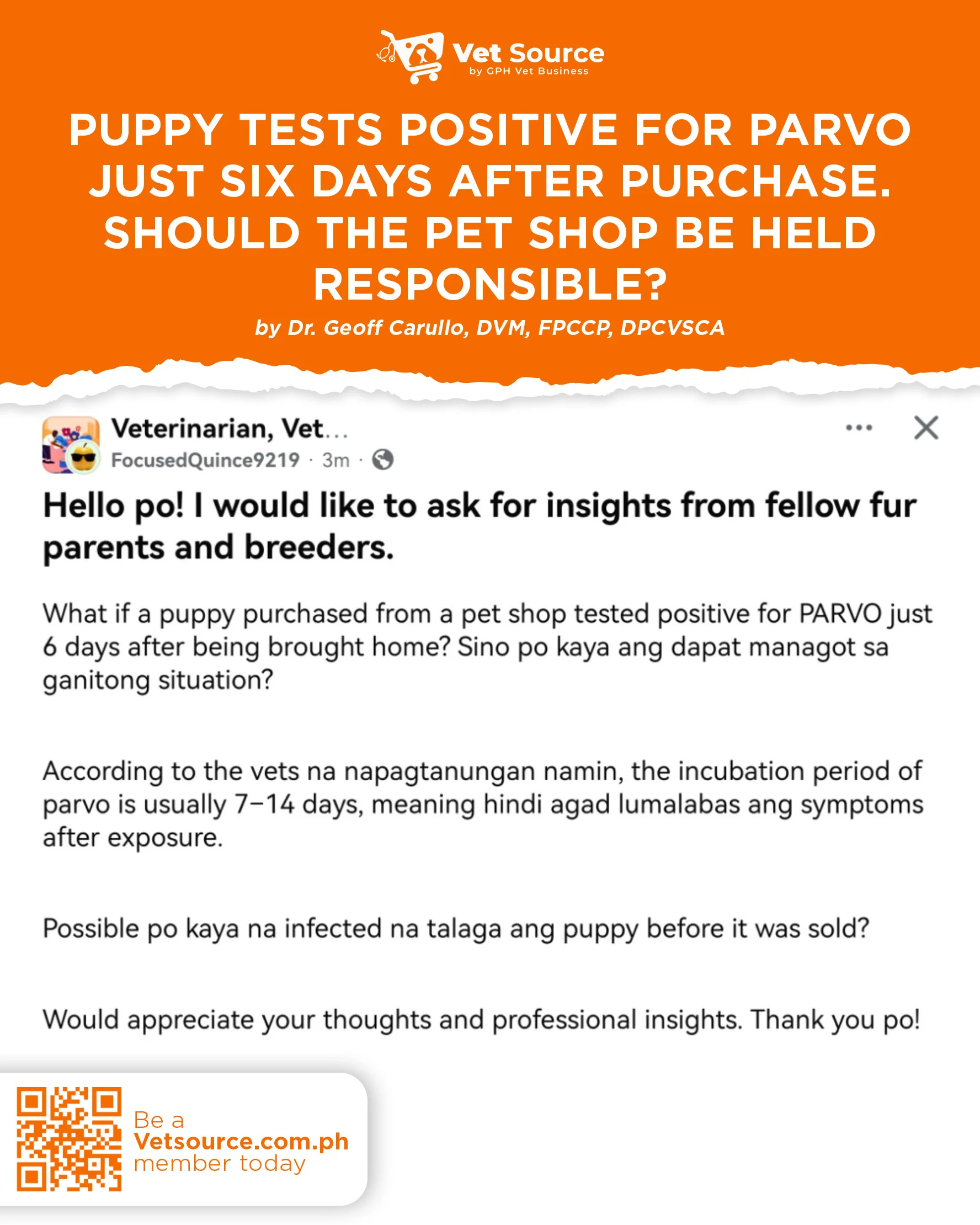
A recent social media discussion raised these questions. However, before assigning blame, there are important scientific and legal considerations worth understanding.
One misconception about canine parvovirus is that its incubation period is usually 7–14 days.
According to Cornell University College of Veterinary Medicine, the typical incubation period is actually 3–7 days.
The incubation period refers to the time between exposure to the virus and the appearance of clinical symptoms.
The Merck Veterinary Manual (2025) further explains that clinical signs generally develop within 5–7 days after infection, although they may appear as early as 2 days or as late as 14 days.
During incubation, an infected puppy may appear perfectly healthy.
It may eat normally, play actively, and show no obvious signs of illness.
Yet the virus may already be multiplying inside its body.
According to the Merck Veterinary Manual, infected dogs can begin shedding parvovirus in their feces approximately 4–5 days after exposure, sometimes before symptoms develop.
This means a puppy can look healthy when purchased but already be infected.
Absolutely.
A puppy testing positive six days after purchase could have acquired the virus while still with the breeder, inside the pet shop, during transportation, or after arriving at its new home.
All are medically possible.
For example, if a puppy develops clinical symptoms six days after purchase, its exposure could have occurred before or after the sale.
The timing alone cannot establish the exact source of infection.
However, if vomiting, diarrhea, or loss of appetite started just one or two days after purchase, this may strengthen the suspicion that exposure occurred before the puppy was brought home.
Still, suspicion is not the same as proof.
Another important distinction is that the date of a positive test is not necessarily the date clinical illness began.
Veterinarians must evaluate the clinical history, vaccination records, symptoms, and diagnostic findings.
The Merck Veterinary Manual also explains that recent vaccination with certain modified-live parvovirus vaccines can occasionally affect fecal antigen test results.
Therefore, proper clinical interpretation is essential.

This is where the discussion becomes particularly interesting.
Under Article 1575 of Republic Act No. 386, otherwise known as the Civil Code of the Philippines:
“The sale of animals suffering from contagious diseases shall be void.”
This provision is particularly relevant because canine parvovirus is a highly contagious disease.
However, its application to a particular transaction requires establishing the relevant facts, including whether the puppy was already infected at the time of sale.
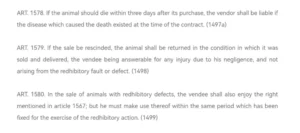
The Civil Code also contains provisions concerning hidden defects in animals.
Under Article 1576, certain hidden defects that cannot be discovered even through expert inspection may be considered redhibitory.
Meanwhile, Article 1577 generally provides a 40-day period from delivery for bringing a redhibitory action involving animal defects, subject to the conditions stated in the law.
Depending on the circumstances and available evidence, a buyer may have legal remedies.
But a positive parvovirus test six days after purchase does not automatically establish that the pet shop violated the law.
The critical question is whether the infection existed when the animal was sold.
Instead of immediately accusing the seller on social media, the buyer should document the circumstances.
Important evidence may include:
The buyer should promptly notify the pet shop, preferably in writing, and request its explanation and relevant records.
If the dispute cannot be resolved, appropriate legal advice and formal remedies should be considered.
Most importantly, the sick puppy needs immediate veterinary treatment and isolation.
According to Cornell University College of Veterinary Medicine, parvovirus can cause severe dehydration and life-threatening complications. Early veterinary intervention is essential.
Selling puppies is not simply about collecting payment and handing an animal to its new owner.
It carries responsibilities.
Proper vaccination schedules, sanitation, disease surveillance, isolation procedures, and accurate medical documentation are essential.
A puppy that appears healthy today may already be incubating a potentially fatal infectious disease.
This is precisely why responsible breeding and selling practices matter.
Can a puppy purchased from a pet shop test positive for parvovirus six days later because it was already infected before the sale?
YES. MEDICALLY, THAT IS ENTIRELY POSSIBLE.
Does that automatically mean the pet shop is legally responsible?
NO. NOT WITHOUT SUFFICIENT EVIDENCE.
Veterinary medicine can help establish when infection may have occurred, but incubation periods alone cannot identify precisely where transmission happened.
And while buyers have the right to demand accountability, sellers also deserve a fair evaluation of the facts.
Remember:
A positive parvovirus test establishes a medical concern. It does not, by itself, establish who is legally responsible.
The goal should be to protect the puppy, establish the facts, and pursue accountability where the evidence supports it.
Because when a puppy becomes seriously ill, the priority should always be saving its life—not winning an argument on social media.
Dr. Geoff Carullo is a Fellow and the current President of the Philippine College of Canine Practitioners.
Sharing this helps others understand what it really means to be a vet. Like and follow if you’re with us.