More Foam, Stronger Chlorhexidine? A 2026 Study Challenges What We Know About Medicated Shampoos
Dr. Geoff Carullo, DVM, FPCCP, DPCVSCA
- Articles
- 5 min read

When prescribing medicated shampoos for canine skin infections, veterinarians often look at one important number: the chlorhexidine concentration.
2%? 3%? Or 4%?
Naturally, we might assume that a shampoo containing 4% chlorhexidine should be more effective than one containing 2%.
But a study published in the February 2026 issue of Veterinary Dermatology suggests that the answer is not that simple.
And here’s another interesting question:
Does a shampoo that produces more foam actually clean or disinfect better?
Apparently, more bubbles do not necessarily mean better antibacterial activity.
Researchers from Iowa State University evaluated 12 antimicrobial preparations:
These products were tested against two isolates of Staphylococcus pseudintermedius, including one methicillin-resistant isolate (MRSP).
This bacterium is particularly important in veterinary dermatology because it is a major cause of canine bacterial pyoderma.
The researchers measured two important laboratory parameters:
They also evaluated how much foam the shampoos produced and how long that foam remained stable.
This was one of the most interesting findings.
Some shampoos containing 2% chlorhexidine combined with 2% miconazole demonstrated strong antibacterial activity, with lower inhibitory concentrations than several other chlorhexidine preparations.
Meanwhile, the two 4% chlorhexidine shampoos also demonstrated strong antibacterial activity.
The important observation was that antibacterial performance could not be reliably predicted by chlorhexidine concentration alone.
In other words, a 4% shampoo is not automatically superior to every 2% shampoo.
The complete formulation matters.
Other active ingredients, inactive ingredients, and their interactions may influence how a shampoo performs.
However, these results do not establish which formulation is clinically superior when used on dogs.
Many pet owners associate abundant foam with effective cleaning.
But the study found no meaningful correlation between lathering ability and measured antibacterial efficacy.
Some shampoos produced more foam than others, yet this did not reliably predict their ability to inhibit or kill bacteria.
This is particularly interesting because pet owners often judge shampoo quality based on how well a product lathers.
A shampoo can produce impressive bubbles without necessarily having superior antibacterial activity.
Of course, adequate lather may still help spread the product across the coat and improve the bathing experience.
But foam should never be mistaken for proof of antimicrobial effectiveness.
Here is something veterinarians should explain more carefully to clients.
During bathing, medicated shampoos inevitably become diluted.
But what happens when owners use too little shampoo and excessive amounts of water?
The concentration of the active ingredients decreases.
The researchers demonstrated that antibacterial activity varied across shampoo dilutions. They raised the possibility that excessive dilution during home bathing could affect treatment performance.
However, the study did not directly measure how pet owners dilute shampoo during actual bathing.
The clinical lesson: Medicated shampoos are not ordinary grooming products. Proper application matters.
Interestingly, the 2025 International Society for Companion Animal Infectious Diseases (ISCAID) guidelines already emphasize topical antimicrobial therapy as the treatment of choice for many cases of canine superficial bacterial folliculitis.
For appropriate cases involving widespread lesions, the guidelines recommend:
These recommendations are based on broader clinical evidence, not solely on the new shampoo comparison study.
Avoid contact with the eyes because chlorhexidine can cause serious ocular irritation or injury.
Before anyone starts declaring one shampoo brand superior to another, we need to understand the study’s limitations.
Only two bacterial isolates were tested, and no dogs were enrolled.
Laboratory conditions cannot fully reproduce what happens on inflamed canine skin, where sebum, exudates, debris, contact time, and owner compliance can influence treatment outcomes.
The findings also cannot automatically be applied to other products with similar chlorhexidine percentages.
Larger clinical studies are needed to determine whether the laboratory differences translate into meaningful treatment differences.
We sometimes pay too much attention to the percentage printed on a shampoo bottle.
But effective treatment involves more than choosing a higher concentration.
It involves selecting an appropriate formulation, establishing a diagnosis, educating owners about proper bathing, and monitoring clinical response.
Remember that recurrent pyoderma may reflect an underlying problem such as allergic skin disease, ectoparasites, or another predisposing condition.
Simply changing shampoo brands will not necessarily solve the problem.
And perhaps the most important takeaway from this research is this:
More chlorhexidine does not automatically mean better antibacterial performance. More foam does not mean more bacteria are killed.
The percentage matters.
The formulation matters.
But ultimately, what matters most is whether the treatment works for the patient.
Because in veterinary dermatology, we should be treating skin disease—not simply washing dogs.
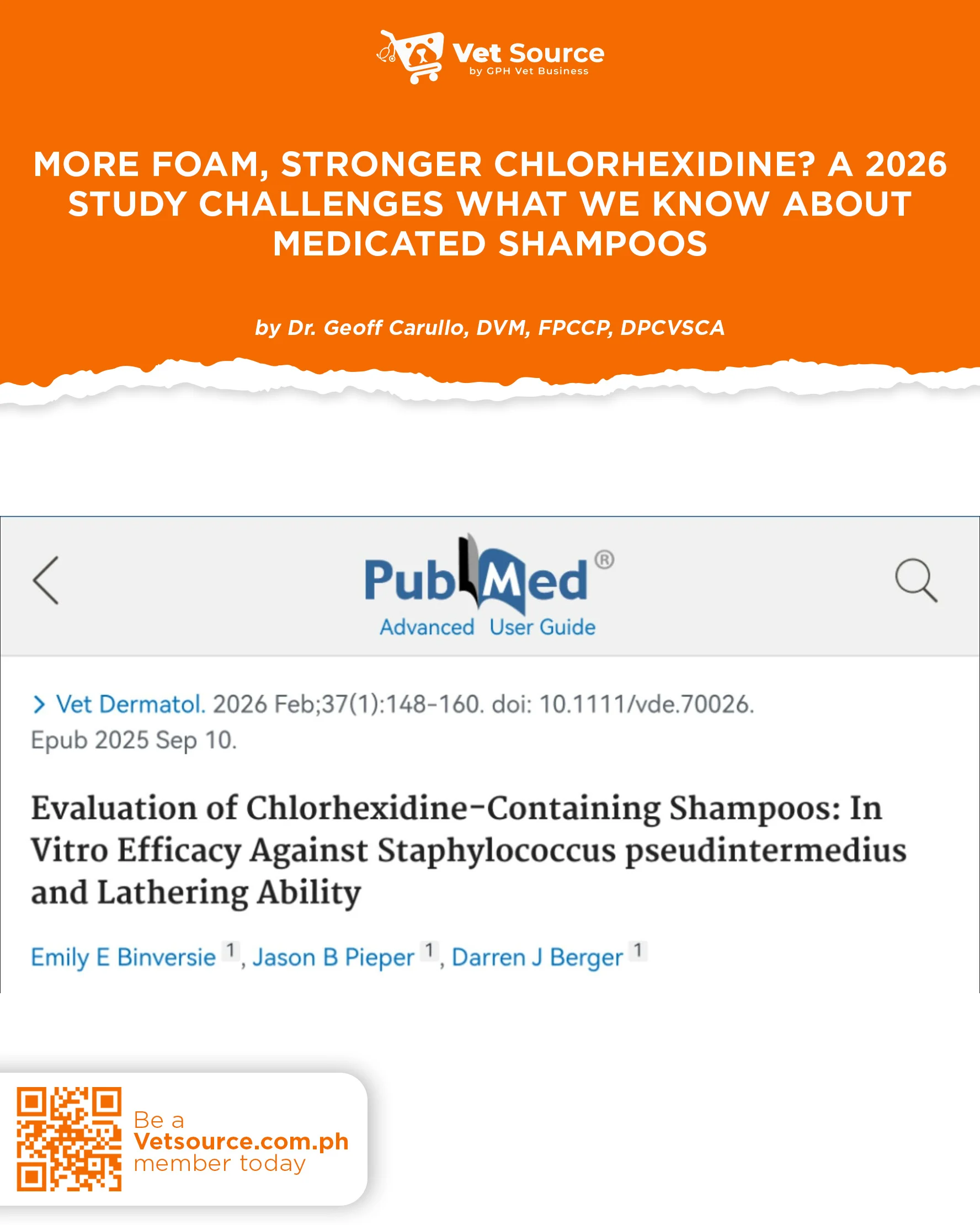
Binversie EE, Pieper JB, Berger DJ. (2026).
Evaluation of Chlorhexidine-Containing Shampoos: In Vitro Efficacy Against Staphylococcus pseudintermedius and Lathering Ability.
Veterinary Dermatology. 37(1):148–160.
First published online: September 10, 2025.
DOI: 10.1111/vde.70026
PMID: 40926723
Dr. Geoff Carullo is a Fellow and the current President of the Philippine College of Canine Practitioners.
Sharing this helps others understand what it really means to be a vet. Like and follow if you’re with us.